
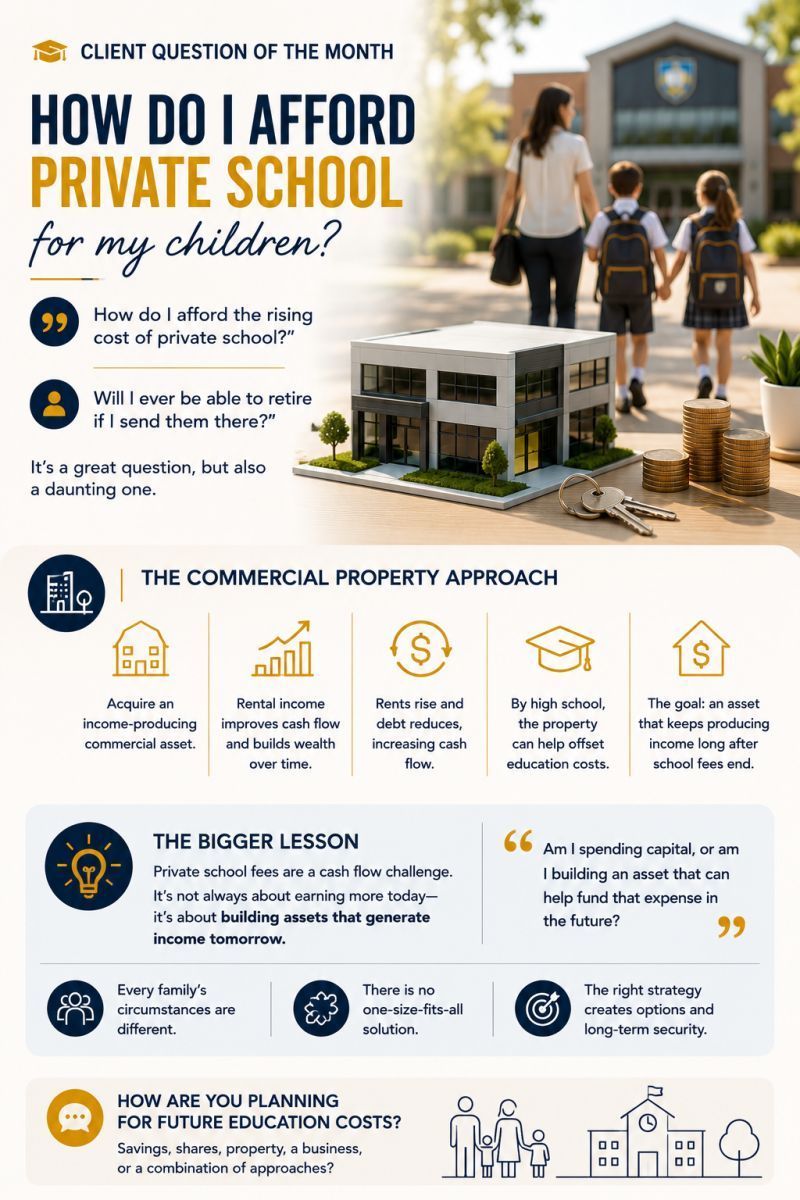
A conversation I've had repeatedly with clients over the past month—and one that's likely on many parents' minds—is:
"How do I afford the rising cost of private school?"
Which is often followed by:
"Will I ever be able to retire if I send them there?"
It's a great question, but also a daunting one.
For many families, private school fees can feel like a major financial hurdle. The challenge is not simply finding the money for the next school term—it's doing so without compromising long-term financial security.
🏢 The Commercial Property Approach
One strategy some families consider is acquiring an income-producing commercial property.
Rather than viewing school fees as an expense that must be funded solely from employment income, the goal is to build an asset that can help contribute towards those costs over time.
A family may spend several years building a deposit before purchasing a commercial property that generates a strong rental yield.
As rents increase and debt is progressively reduced, the property's cash flow can improve significantly. By the time children reach high school, the property may be contributing meaningful income that helps offset education expenses.
Over the long term, the objective isn't simply to pay school fees.
It's to create an asset that continues producing income long after those fees have ended.
💡 The Bigger Lesson
Private school fees are ultimately a cash flow challenge.
The solution isn't always about earning more income today.
Often, it's about building assets that generate income tomorrow.
Every family's circumstances are different, and there is no one-size-fits-all solution.
However, when evaluating major life expenses, it can be worth asking:
"Am I simply funding an expense, or am I building an asset that can help fund that expense in the future?"
That question alone can completely change the way you approach long-term financial planning.
